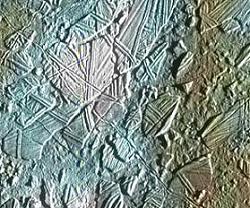
Above: Fragmented chunks of ice on Europa,
similar in appearance to those seen in Earth polar seas during a
springtime thaw. [more
information] |
A future guide book for Solar System vacationers might describe
Jupiter's moon Europa this way: "Europa is cold -- really cold. The
surface temperature is a chilly -260 deg F, so bring your space parka. The
entire planet is covered with a relatively smooth layer of frozen water
and ice skating is allowed in most regions. Travelers should bring their
own air, as Europa's oxygen atmosphere is a million times thinner than
Earth's. Other items of note include cold water volcanoes, gigantic ice
rafts, and an underground ocean. Ice fishing is not encouraged."
It may sound like science fiction, but most of this fanciful
description is true. NASA's Voyager and Galileo spacecraft have shown
Europa to be a frigid world dotted with remnants of "cryo-volcanoes" and
rafts of ice similar in appearance to those seen on Earth's polar seas
during springtime thaws. As astonishing as the surface sounds, Europa may
be even more interesting underground. Many scientists think that tidal
friction from nearby Jupiter heats the interior of the moon to
temperatures where liquid water is possible. Beneath its icy crust, Europa could
harbor the solar system's largest ocean!
Aside from the novelty of
oceans on another planet, scientists are fascinated by the possibility of
Europan seas because they could be sites for extraterrestrial life. Here
on Earth, undersea volcanoes and hydrothermal vents create environments
that sustain rich colonies of microbes. If similar systems are active on
Europa, scientists reason, life might be present there too. If there is an
ocean on Europa, will it contain life? Chris Chyba of the SETI Institute
responds, "Can an ocean of liquid water persist for 4.5 billion years and
not have life in it?." We simply
don't know. Thanks to Science@NASA. |

 Home |
Bios |
Writings |
Pictures |
Games |
News |
Schools |
Links |
More |
About Us
Home |
Bios |
Writings |
Pictures |
Games |
News |
Schools |
Links |
More |
About Us